
Why some people feel afraid to invest
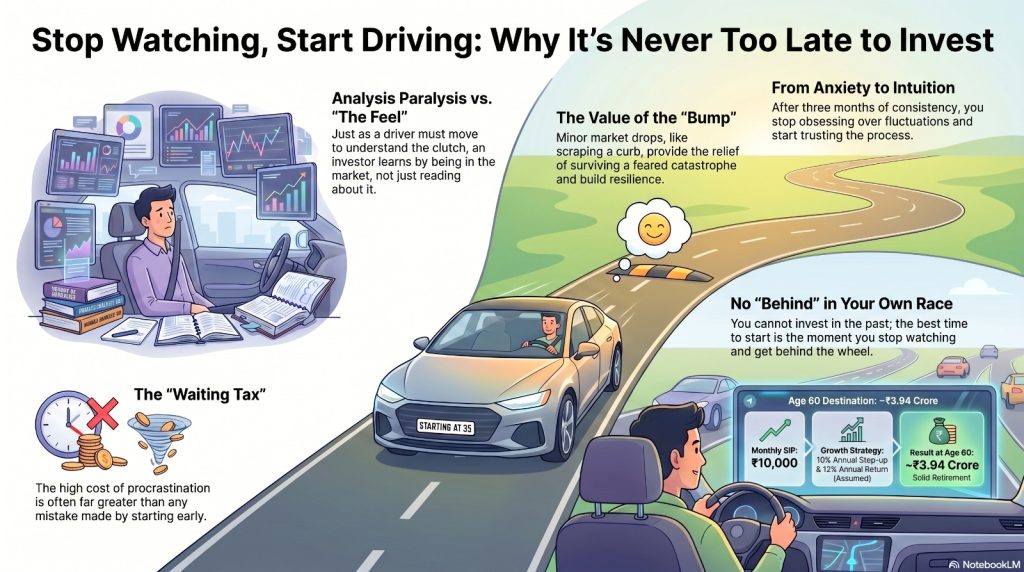
Many people who haven’t started investing yet tend to lean on two main excuses: they believe it’s already too late, or they feel they don’t possess the expert knowledge required to begin. It’s a mindset that can keep someone stuck for years, paralyzed by the idea that they missed a window that everyone else walked through long ago.
Often, it takes a completely unrelated life experience like an adult finally learning to drive a manual car at 33 to realize that the real obstacle isn’t a lack of information or bad timing. It’s the fear that the “right” moment has already passed.
The Struggle of Starting Late
Most people learn to drive in their teens. At that age, they don’t really “learn” so much as they just absorb the skill; they are young enough not to overthink the mechanics or the risks.
When someone decides to start at 33, however, they are old enough to know exactly what can go wrong. On day one, a late learner might stall the car five times before even leaving the parking lot. An instructor might tell them, “Stop thinking. You’re trying to control the mechanics before you understand the feel. Drive first; understand later.” Yet, the learner often keeps over-analysing, stalling a sixth time because they are trying to master the theory instead of gaining the experience. This is the exact feeling many have when they open a mutual fund app, stare at the overwhelming options, and promptly close it. The fear of needing to know everything before doing anything keeps the engine off.
Why the “Bump” is Necessary
Eventually, every learner hits a curb or misjudges a turn. It usually happens slowly a minor scrape or a sudden jolt where the mistake is made and they just have to watch it play out.
In that moment, a strange thing happens: relief. The catastrophe they had been dreading finally occurred, and the world didn’t end. The car is fine, and they are fine. The fear of the mistake was significantly more exhausting than the mistake itself. This is a crucial lesson for the hesitant investor. Many spend years waiting for the markets to “calm down” or for a “guarantee” that their portfolio won’t drop. But no such guarantee exists. The “drop” is actually where the most important learning happens.
From Analysis to Intuition
By the third month of consistent practice, the learner’s relationship with the car changes. They stop counting gears and obsessing over the clutch. They stop checking the dashboard every five seconds. A basic trust forms not mastery, but familiarity. They know how the car handles a hill or how it behaves in the rain. They stop fighting the machine and start moving with it.
Investing works on the same timeline. Initially, every fluctuation feels like a life-altering decision. But for those who stay the course, the anxiety eventually quiets down. Having lived through a market correction or a “red” month, the investor stops reacting and starts trusting the process.
That shift doesn’t come from reading more books; it comes from staying in the market long enough to have lived through a cycle. The market’s job isn’t to provide comfort it’s to reward those who can handle being uncomfortable for a while.
The Reality of the Numbers
Is it actually too late to start at 35? The math suggests otherwise.
If a 35-year-old starts a monthly SIP of ₹10,000 and increases that amount by 10% every year, they can accumulate roughly ₹3.94 crore by age 60. This assumes a 12% annual return, which is a reasonable long-term expectation for diversified equity.
That isn’t a consolation prize; that is a solid retirement. Those who wait for the “perfect” moment end up paying a “waiting tax” a cost that is usually far higher than any initial mistake they might have made by starting early.
Closing the Imaginary Window
While starting at 22 is objectively better for compounding, the reality is that no one can invest in the past. One can only invest today, from where they are, with what they have.
People often convince themselves that the window has closed or that they are “starting behind.” But there is no “behind” in a race against your own future. The perfect moment is a myth used to make procrastination feel like caution. It isn’t wisdom; it’s just waiting.
The best time to start was years ago, but the second-best time is the moment one decides to stop watching the traffic and finally get behind the wheel.